Energy Storage Science and Technology
Kai Wang( ), Jiarui Wang, Min Zhu, Jun Liu()
Received:2025-04-23
Revised:2025-05-02
Contact:
Jun Liu
E-mail:862887395@qq.com;msjliu@scut.edu.cn
Kai Wang, Jiarui Wang, Min Zhu, Jun Liu. Methods, applications and challenges of recovering anode graphite from spent lithium-ion batteries[J]. Energy Storage Science and Technology, doi: 10.19799/j.cnki.2095-4239.2025.0385.
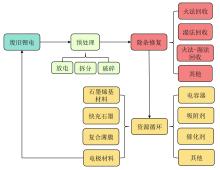
Fig. 1
Flowchart of graphite recycling and regeneration"
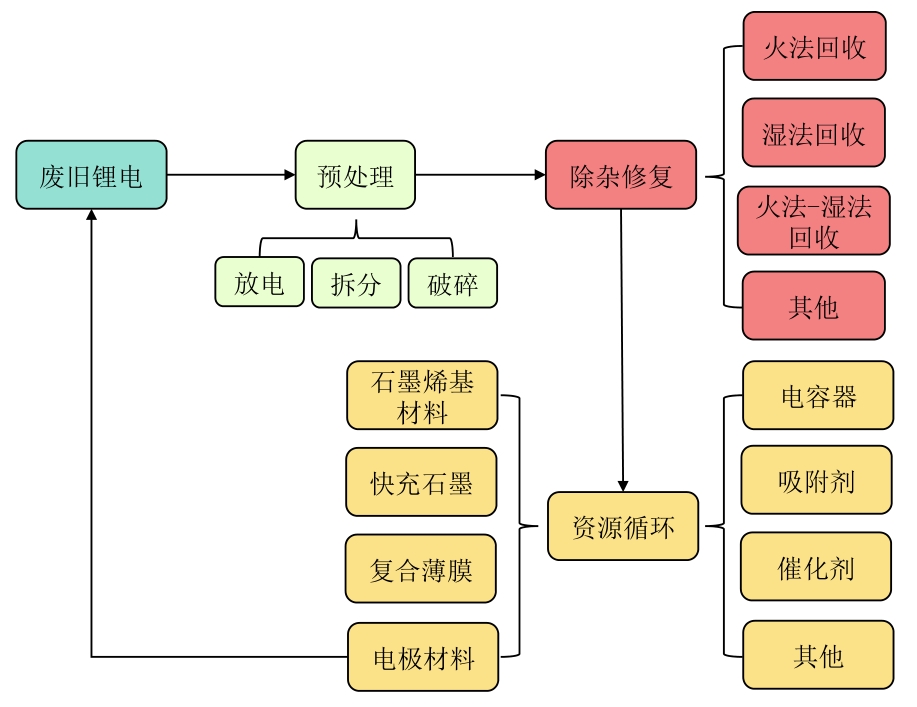
Fig. 2
(a) SEM images and EDS analysis of SG and RG-2800[11];(b) process of removing and recovering anode active materials from spent LIBs[13]; (c) Schematic diagram of spent graphite regeneration process of Samsung lithium battery pack[17]; (d) Schematic diagram of spent graphite anode material pretreatment and acid leaching process[18]; (e) Regeneration mechanism of spent graphite during DES leaching[19];(f) Reaction mechanism of sulfuric acid curing leaching and high temperature calcination[20]; (g) Cycling performance of spent graphite(SG), purified graphite(PG), regenerated (RG) and commercial graphite (CG) at the rate of 0.1 C after 50 cycles[20]; (h) HRTEM images of SG, PG and HTT-900[21]; (i) Flow chart of graphite recovery by microwave heating method[25](j) The rate performance and cycling performance at 0.5 C of regenerated graphite (RG) and commercial graphite (CG) recovered by microwave heating method[25]"
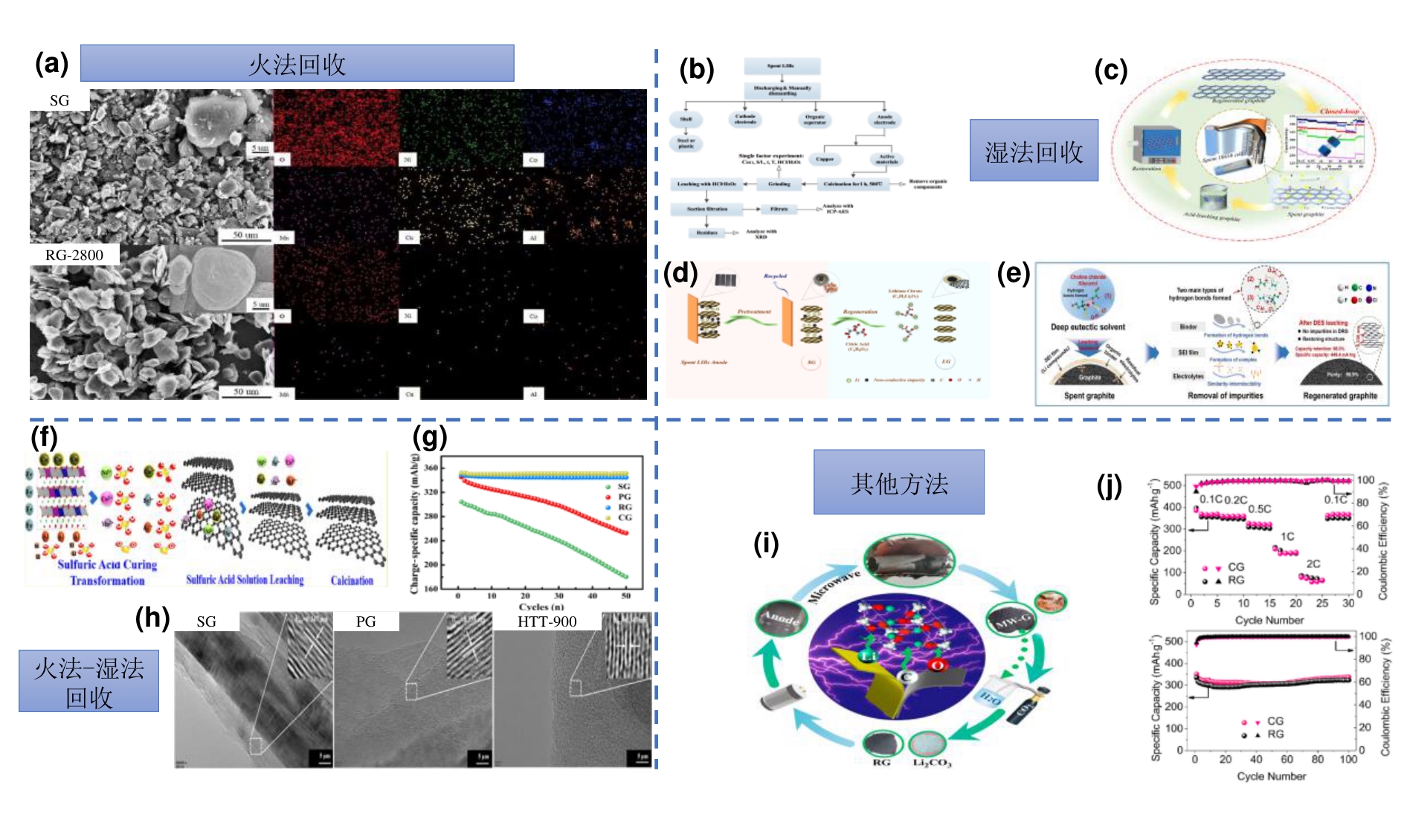
Table 1
Recycle and recovery strategy of spent graphite and electrochemical performance of regenerated graphite"
| 回收策略 | 具体方法 | 首次库伦效率/% | 可逆容量 [mAh g-1] | 循环性能 | 参考文献 |
|---|---|---|---|---|---|
| 火法回收 | 750 ℃, 5 h | 98.00% | 315, 0.5 A g-1 | 368 mAh g-1, 300圈循环, 0.5 C | [ |
| 1673 K, 4 h | 62.91% | 675.4, 0.1 C | 360.8 mAh g-1, 100圈循环, 1 C | [ | |
| 2800 ℃, 12 h | 88.80% | 346.3, 0.1 C | 345.7 mAh g-1, 100圈循环, 0.1 C | [ | |
| 3000 ℃, 6 h | - | 352.5, 0.1 A g-1 | 97.3%, 1000圈循环, 0.1 A g-1 | [ | |
| 湿法回收 | H2SO4 | - | 377.3, 0.1 C | 84.63%, 100圈循环, 0.1 C | [ |
| H2SO4和HNO3 | 80.06% | 366.2, 0.1 C | 363.5 mAh g-1, 100圈循环, 0.5 C | [ | |
| H3BO3 | - | 330, 0.3 C | 333 mAh g-1, 100圈循环, 0.3 C | [ | |
| C6H8O7 | - | 332.8, 0.1 C | 330 mAh g-1, 80圈循环, 0.5 C | [ | |
| 火法-湿法回收 | H2SO4 和1500 ℃, 2 h | 88.30% | 349, 0.1 C | 345 mAh g-1, 50圈循环, 0.1 C | [ |
| HCl 和 2600 ℃, 2 h | - | 359, 0.2 C | 359 mAh g-1, 70圈循环, 0.2 C | [ | |
| H2SO4, C6H8O7和750 ℃, 5 h | - | 401-413, 0.1 A g-1 | 403 mAh g-1, 100圈循环, 0.1 A g-1 | [ | |
| 其他方法 | 微波回收 | 80.60% | 353.5, 0.1 C | 96.6%, 100圈循环, 0.5 C | [ |
| 闪光焦耳加热 | - | 343, 1 C | 99%, 500圈循环, 1 C | [ | |
| 泡沫浮选 | 86.8% | 350, 1/20 C | 80%, 1000圈循环, 1/20 C | [ | |
| 电化学回收 | 81.92% | 427.81, 0.1 C | 87.4%, 100圈循环, 0.5 C | [ |
| 1 | CHENG X B, ZHANG R, ZHAO C Z, et al. Toward safe lithium metal anode in rechargeable batteries: A review [J]. Chemical Reviews, 2017, 117(15): 10403-10473. http://dx.doi.org/10.1021/acs.chemrev.7b00115 |
| 2 | ZHAO L, TIAN L, LI J, et al. Recent progress in the recycling of spent graphite anodes: Failure mechanisms, repair techniques, and prospects [J]. Energy Storage Materials, 2024, 71: 103640. http://dx.doi.org/https://doi.org/10.1016/j.ensm.2024.103640 |
| 3 | SRIVASTAVA V, RANTALA V, MEHDIPOUR P, et al. A comprehensive review of the reclamation of resources from spent lithium-ion batteries [J]. Chemical Engineering Journal, 2023, 474: 145822. http://dx.doi.org/https://doi.org/10.1016/j.cej.2023.145822 |
| 4 | SONG S-L, LIU R-Q, SUN M-M, et al. Hydrometallurgical recovery of lithium carbonate and iron phosphate from blended cathode materials of spent lithium-ion battery [J]. Rare Metals, 2024, 43(3): 1275-1287. http://dx.doi.org/10.1007/s12598-023-02493-9 |
| 5 | BABANEJAD S, AHMED H, ANDERSSON C, et al. Pyrometallurgical approach to extracting valuable metals from a combination of diverse li-ion batteries' black mass [J]. ACS Sustainable Resource Management, 2024, 1(8): 1759-1767. http://dx.doi.org/10.1021/acssusresmgt.4c00117 |
| 6 | GEROLD E, KADISCH F, LERCHBAMMER R, et al. Bio-metallurgical recovery of lithium, cobalt, and nickel from spent nmc lithium ion batteries: A comparative analysis of organic acid systems [J]. Journal of Hazardous Materials Advances, 2024, 13: 100397. http://dx.doi.org/https://doi.org/10.1016/j.hazadv.2023.100397 |
| 7 | LIU T, YAN Z, XIN W, et al. Short-time and high-performance recovery of critical metal elements from spent ternary lithium-ion batteries by selective synergic coordination effect [J]. Advanced Functional Materials, 2024, n/a(n/a): 2417883. http://dx.doi.org/https://doi.org/10.1002/adfm.202417883 |
| 8 | NATARAJAN S, DIVYA M L, ARAVINDAN V. Should we recycle the graphite from spent lithium-ion batteries? The untold story of graphite with the importance of recycling [J]. Journal of Energy Chemistry, 2022, 71: 351-369. http://dx.doi.org/https://doi.org/10.1016/j.jechem.2022.04.012 |
| 9 | ZENG X, LI M M, EL-HADY D A, et al. Commercialization of lithium battery technologies for electric vehicles [J]. Advanced Energy Materials, 2019, 9. |
| 10 | ZHAO L, TIAN L, LI J, et al. Recent progress in the recycling of spent graphite anodes: Failure mechanisms, repair techniques, and prospects [J]. Energy Storage Materials, 2024, 71. http://dx.doi.org/10.1016/j.ensm.2024.103640 |
| 11 | YU G-Q, XIE M-Z, ZHENG Z-H, et al. Efficiently regenerating spent lithium battery graphite anode materials through heat treatment processes for impurity dissipation and crystal structure repair [J]. Resources, Conservation and Recycling, 2023, 199: 107267. http://dx.doi.org/10.1016/j.resconrec.2023.107267 |
| 12 | YU H, DAI H, ZHU Y, et al. Mechanistic insights into the lattice reconfiguration of the anode graphite recycled from spent high-power lithium-ion batteries [J]. Journal of Power Sources, 2021, 481: 229159. http://dx.doi.org/10.1016/j.jpowsour.2020.229159 |
| 13 | GUO Y, LI F, ZHU H, et al. Leaching lithium from the anode electrode materials of spent lithium-ion batteries by hydrochloric acid (HCl) [J]. Waste Management, 2016, 51: 227-233. http://dx.doi.org/10.1016/j.wasman.2015.11.036 |
| 14 | YANG Y, SONG S, LEI S, et al. A process for combination of recycling lithium and regenerating graphite from spent lithium-ion battery [J]. Waste Management, 2019, 85: 529-537. http://dx.doi.org/10.1016/j.wasman.2019.01.008 |
| 15 | MA X, CHEN M, CHEN B, et al. High-performance graphite recovered from spent lithium-ion batteries [J]. ACS Sustainable Chemistry & Engineering, 2019, 7(24): 19732-19738. http://dx.doi.org/10.1021/acssuschemeng.9b05003 |
| 16 | NATARAJAN S, BHATTARAI R M, SUDHAKARAN M S P, et al. Recycling of spent graphite and copper current collector for lithium-ion and sodium-ion batteries [J]. Journal of Power Sources, 2023, 577: 233170. http://dx.doi.org/10.1016/j.jpowsour.2023.233170 |
| 17 | TIAN H, GRACZYK-ZAJAC M, DE CAROLIS D M, et al. A facile strategy for reclaiming discarded graphite and harnessing the rate capabilities of graphite anodes [J]. Journal of Hazardous Materials, 2023, 445: 130607. http://dx.doi.org/10.1016/j.jhazmat.2022.130607 |
| 18 | YANG J, FAN E, LIN J, et al. Recovery and reuse of anode graphite from spent lithium-ion batteries via citric acid leaching [J]. ACS Applied Energy Materials, 2021, 4(6): 6261-6268. http://dx.doi.org/10.1021/acsaem.1c01029 |
| 19 | LAI Y, ZHU X, LI J, et al. Recovery and regeneration of anode graphite from spent lithium-ion batteries through deep eutectic solvent treatment: Structural characteristics, electrochemical performance and regeneration mechanism [J]. Chemical Engineering Journal, 2023, 457: 141196. http://dx.doi.org/10.1016/j.cej.2022.141196 |
| 20 | GAO Y, WANG C, ZHANG J, et al. Graphite recycling from the spent lithium-ion batteries by sulfuric acid curing–leaching combined with high-temperature calcination [J]. ACS Sustainable Chemistry & Engineering, 2020, 8(25): 9447-9455. http://dx.doi.org/10.1021/acssuschemeng.0c02321 |
| 21 | GAO Y, ZHANG J, JIN H, et al. Regenerating spent graphite from scrapped lithium-ion battery by high-temperature treatment [J]. CARBON, 2022, 189: 493-502. http://dx.doi.org/10.1016/j.carbon.2021.12.053 |
| 22 | ROTHERMEL S, EVERTZ M, KASNATSCHEEW J, et al. Graphite recycling from spent lithium-ion batteries [J]. ChemSusChem, 2016, 9(24): 3473-3484. http://dx.doi.org/10.1002/cssc.201601062 |
| 23 | JIANG Z, SUN J, JIA P, et al. A sustainable strategy for spent li-ion battery regeneration: Microwave-hydrothermal relithiation complemented with anode-revived graphene to construct a LiFePO4/MWrGO cathode material [J]. Sustainable Energy & Fuels, 2022, 6(9): 2207-2222. http://dx.doi.org/10.1039/d1se01750k |
| 24 | CAO N, ZHANG Y, CHEN L, et al. An innovative approach to recover anode from spent lithium-ion battery [J]. Journal of Power Sources, 2021, 483: 229163. http://dx.doi.org/10.1016/j.jpowsour.2020.229163 |
| 25 | YUWEN C, LIU B, ZHANG H, et al. Efficient recovery and regeneration of waste graphite through microwave stripping from spent batteries anode for high-performance lithium-ion batteries [J]. Journal of Cleaner Production, 2022, 333: 130197. http://dx.doi.org/10.1016/j.jclepro.2021.130197 |
| 26 | DONG S, SONG Y, YE K, et al. Ultra-fast, low-cost, and green regeneration of graphite anode using flash joule heating method [J]. EcoMat, 2022, 4(5): e12212. http://dx.doi.org/10.1002/eom2.12212 |
| 27 | BHAR M, BHATTACHARJEE U, SARMA D, et al. A novel and sustainable approach to enhance the li-ion storage capability of recycled graphite anode from spent lithium-ion batteries [J]. ACS Applied Materials & Interfaces, 2023, 15(22): 26606-26618. http://dx.doi.org/10.1021/acsami.3c02272 |
| 28 | YI C, YANG Y, ZHANG T, et al. A green and facile approach for regeneration of graphite from spent lithium ion battery [J]. Journal of Cleaner Production, 2020, 277. http://dx.doi.org/10.1016/j.jclepro.2020.123585 |
| 29 | MARKEY B, ZHANG M, ROBB I, et al. Effective upcycling of graphite anode: Healing and doping enabled direct regeneration [J]. Journal of the Electrochemical Society, 2020, 167(16): 160511. http://dx.doi.org/10.1149/1945-7111/abcc2f |
| 30 | LI Y, LV W, ZHAO H, et al. Regeneration of anode materials from complex graphite residue in spent lithium-ion battery recycling process [J]. Green Chemistry, 2022, 24(23): 9315-9328. http://dx.doi.org/10.1039/D2GC02439J |
| 31 | JEGAN ROY J, TANG E J J, DO M P, et al. Closed-loop graphite recycling from spent lithium-ion batteries through bioleaching [J]. ACS Sustainable Chemistry & Engineering, 2023, 11(17): 6567-6577. http://dx.doi.org/10.1021/acssuschemeng.2c07262 |
| 32 | OLUTOGUN M, VANDERBRUGGEN A, FREY C, et al. Recycled graphite for more sustainable lithium-ion batteries [J]. Carbon Energy, 2024, 6(5): e483. http://dx.doi.org/10.1002/cey2.483 |
| 33 | WANG Y, CAO H, CHEN L, et al. Tailored synthesis of active reduced graphene oxides from waste graphite: Structural defects and pollutant-dependent reactive radicals in aqueous organics decontamination [J]. Applied Catalysis B-Environmental, 2018, 229: 71-80. http://dx.doi.org/10.1016/j.apcatb.2018.02.010 |
| 34 | XIE X, ZHANG J, CHEN Y, et al. A method for the preparation of graphene from spent graphite of retired lithium-ion batteries [J]. Journal of Power Sources, 2024, 594: 234023. http://dx.doi.org/10.1016/j.jpowsour.2023.234023 |
| 35 | SUN F, WANG H, QU Z, et al. Carboxyl-dominant oxygen rich carbon for improved sodium ion storage: Synergistic enhancement of adsorption and intercalation mechanisms [J]. Advanced Energy Materials, 2021, 11(1). http://dx.doi.org/10.1002/aenm.202002981 |
| 36 | SUBRAMANYAN K, AKSHAY M, LEE Y-S, et al. Na-ion battery with graphite anode and Na3V2 (PO4)3 cathode via solvent-Co-intercalation process [J]. Advanced Materials Technologies, 2022, 7(12). http://dx.doi.org/10.1002/admt.202200399 |
| 37 | ZHANG J, LEI Y, ZHOU L, et al. Ball-milling synthesis of richly oxygenated graphene-like nanoplatelets from used lithium ion batteries and its application for high performance sodium ion battery anode [J]. Advanced Functional Materials, 2024, 34(24). http://dx.doi.org/10.1002/adfm.202314160 |
| 38 | ZHENG M, WANG J, QIAN S, et al. Sustainable regeneration of spent graphite as a cathode material for a high-performance dual-ion battery [J]. ACS Sustainable Chemistry & Engineering, 2023, 11(11): 4308-4316. http://dx.doi.org/10.1021/acssuschemeng.2c05124 |
| 39 | KONG Y, TAKAYA Y, CóRDOVA-UDAETA M, et al. A comprehensive approach for the recycling of anode materials from spent lithium-ion batteries: Separation, lithium recovery, and graphite reutilization as environmental catalyst [J]. Waste Management, 2024, 188: 60-71. http://dx.doi.org/10.1016/j.wasman.2024.07.033 |
| 40 | CHEN W, QU H, SHI R, et al. Upcycling spent graphite into fast-charging anode materials through interface regulation [J]. ACS Energy Letters, 2024, 9(7): 3505-3515. http://dx.doi.org/10.1021/acsenergylett.4c01244 |
| [1] | Yingjian CHEN, Shang WU, Yuancheng CAO, Baoshuai DU, Zhenxing WANG, Zhongwen OUYANG, Shun TANG. Application of magnetic separation in the recycling of cathode and anode materials from spent lithium batteries [J]. Energy Storage Science and Technology, 2025, 14(5): 1918-1927. |
| [2] | Yuchao ZHANG, Fengjiao ZHANG, Wei LOU, Feixiang ZAN, Linling WANG, Anxu SHENG, Xiaohui WU, Jing CHEN. Transformation process of valuable metals in the recycling of spent lithium-ion batteries and the potential environmental impact [J]. Energy Storage Science and Technology, 2024, 13(6): 1861-1870. |
| [3] | Zipan NIE, Liye XIAO, Qingquan QIU, Jingye ZHANG. Overview of the development of underground pumped hydro storage [J]. Energy Storage Science and Technology, 2024, 13(5): 1606-1619. |
| [4] | Lei WANG, Xin WANG, Rongrong ZHANG, Zonghao LIU, Shenglong MU, Gang CHEN. Economic analysis of microgrid operation based on carbon neutrality [J]. Energy Storage Science and Technology, 2023, 12(1): 319-328. |
| [5] | Qunbin ZHANG, Tao DONG, Jingjing LI, Yanxia LIU, Haitao ZHANG. Research progress on the recovery and high-value utilization of spent electrolyte from lithium-ion batteries [J]. Energy Storage Science and Technology, 2022, 11(9): 2798-2810. |
| [6] | Wei LIU, Yanming WAN, Yalin XIONG, Jian LIU. Outlook of low carbon and clean hydrogen in China under the goal of "carbon peak and neutrality" [J]. Energy Storage Science and Technology, 2022, 11(2): 635-642. |
| [7] | Haisheng CHEN, Chang LIU, Yujie XU, Fen YUE, Wei LIU, Zhenhua YU. The strategic position and role of energy storage under the goal of carbon peak and carbon neutrality [J]. Energy Storage Science and Technology, 2021, 10(5): 1477-1485. |
| [8] | Linlin LI, Yujie WANG, Yifei MEN, Wei YANG, Hanbo ZOU, Shengzhou CHEN. Research progress of inorganic acids in hydrometallurgical recovery technology [J]. Energy Storage Science and Technology, 2021, 10(1): 68-76. |
| [9] | Linlin LI, Linjuan CAO, Yongxiong MAI, Yifei MEN, Wei YANG, Shengzhou CHEN. Research progress of the organic acid of the hydrometallurgical recovery technology in spent Li ion batteries [J]. Energy Storage Science and Technology, 2020, 9(6): 1641-1650. |
| Viewed | ||||||
|
Full text |
|
|||||
|
Abstract |
|
|||||

