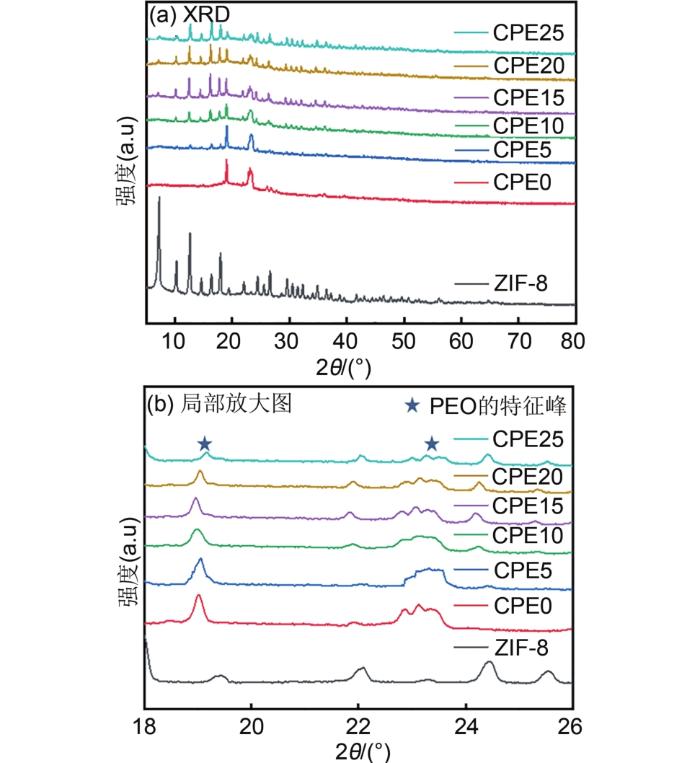
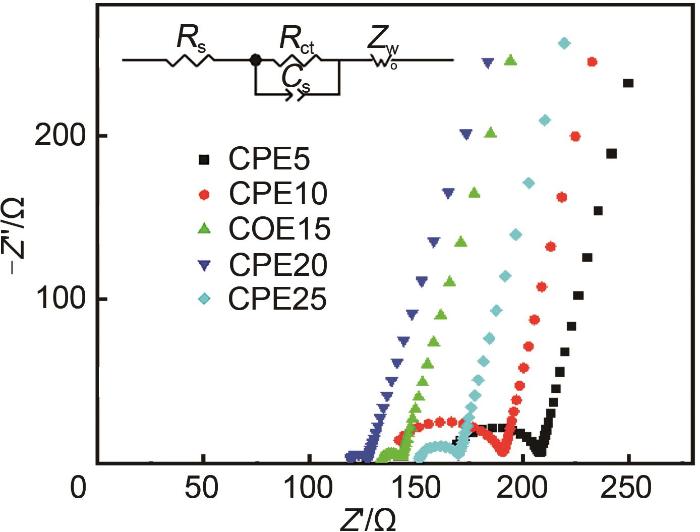
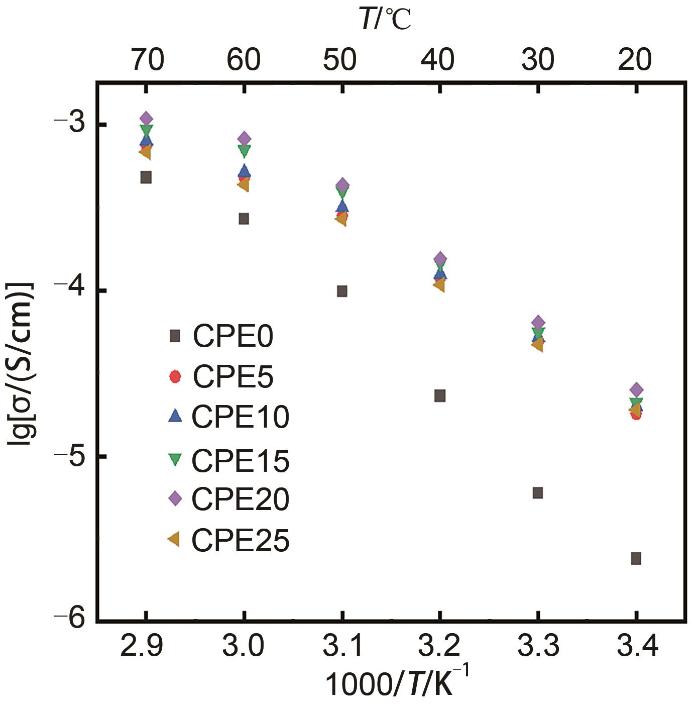
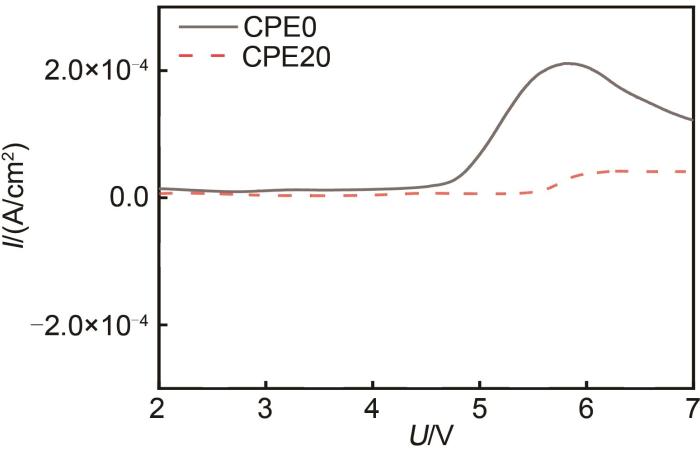
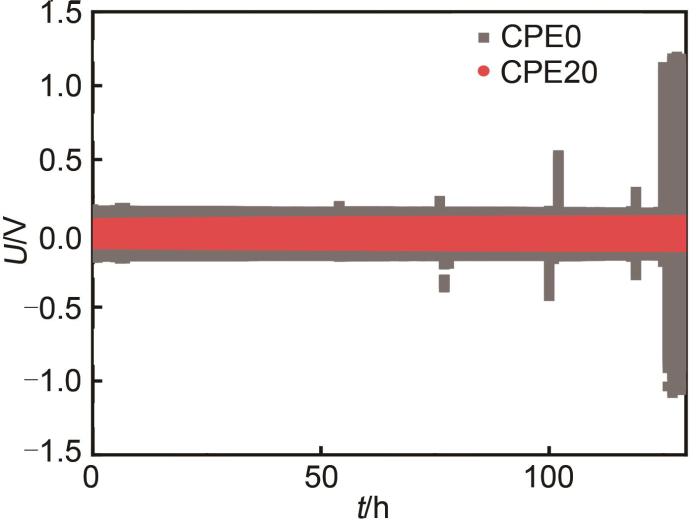
Incorporating inorganic fillers into polyethylene oxide (PEO)-based solid polymer electrolytes is a low-cost and effective method to improve their mechanical and electrochemical properties. The solid electrolyte composite of zeolite imidazole skeleton material (ZIF-8) and PEO was prepared using flow-casting method to effectively improve the electrochemical performance of the PEO solid electrolyte. Physical characterizations of scanning electron microscopy, X-ray diffraction, and electrochemical measurement methods, such as electrochemical impedance spectroscopy, linear sweep voltammetry, and charge-discharge cycle, proved that the PEO-based composite solid electrolyte CPE20 with 20%ZIF-8 nanoparticles had the lowest resistance, a broader electrochemical stability window, and an activation energy of 8.4×10⁻³ eV. At 20 ℃, the conductivity of CPE20 reached 4.9×10⁻⁵ S/cm, which is one order of magnitude higher than that of pure PEO. When the temperature was increased to 70 ℃, the conductivity reached 1.08×10⁻³ S/cm. The number of lithium-ion transference of CPE20 increased to 0.46, while that of pure PEO solid electrolyte is 0.36. Thus, the CPE20 preparation of LiFePO4||Li battery has good capacity and cycle performance at room temperature, with a capacity rate of more than 96%. Therefore, adding an appropriate amount of ZIF-8 inert filler can effectively reduce the crystallinity and increase the amorphous zone of the polymer. It can also promote the dissolution of lithium salts and improve the mobility of lithium ions, which make the composite solid electrolyte has more excellent electrochemical performance. Thus, the findings show that the PEO-based solid polymer electrolytes with ZIF-8 have potential application in solid-state lithium batteries.
Keywords:chemical energy storage
;
electrolytes
;
polyvinyl oxide
;
zeolite imidazole skeleton material
HUANG Weibin. Preparation and modification of ZIF-8 composite PEO based solid electrolyte[J]. Energy Storage Science and Technology, 2023, 12(4): 1083-1092
图 12
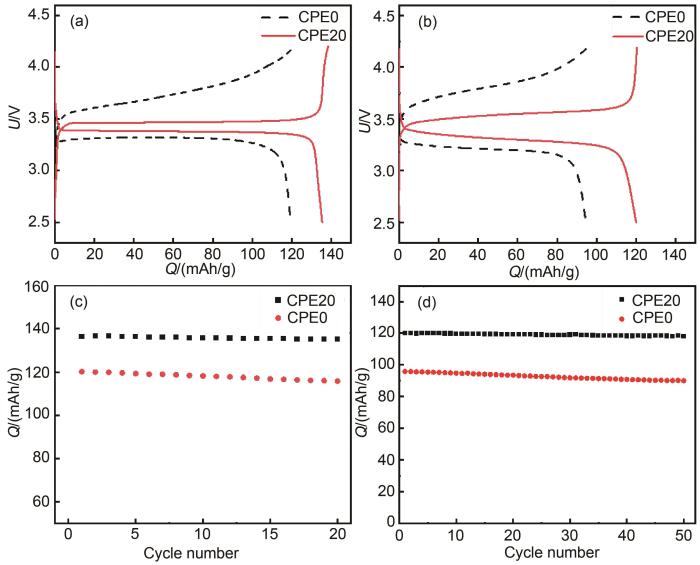
室温下全固态电池在0.1 C (a)和0.5 C (b)电流密度下的首次充放电曲线和在0.1 C (c)和0.5 C (d)电流密度下的循环稳定性图
Fig. 12
First cycle charge-discharge curves of all solid state batteries under (a) 0.1 C and (b) 0.5 C current density and cycle stability diagrams at (c) 0.1 C and (d) 0.5 C current density at room temperature
WANG M Q, LIU X L, QIN B Y, et al. In-situ etching and ion exchange induced 2D-2D MXene@Co9S8/CoMo2S4 heterostructure for superior Na+ storage[J]. Chemical Engineering Journal, 2023, 451: doi: 10.1016/j.cej.2022.138508.
CHEN W, CHEN J L, DENG J Y, et al. Improvement of cycling stability of Li1.2Mn0.54Co0.13Ni0.13O2 microrods cathode material modified with in situ polymerization of aniline in HTFSI solution[J]. International Journal of Energy Research, 2022, 46(15): 22960-22970.
ZHOU W D, HUANG Q, XIE X X, et al. Research progress of polymer electrolyte for solid state lithium batteries[J]. Energy Storage Science and Technology, 2022, 11(6): 1788-1805.
CHENG X B, ZHANG R, ZHAO C Z, et al. A review of solid electrolyte interphases on lithium metal anode[J]. Advanced Science (Weinheim, Baden-Wurttemberg, Germany), 2015, 3(3): doi: 10.1002/advs.201500213.
DU Z Z, AI W, YANG J, et al. In situ fabrication of Ni2P nanoparticles embedded in nitrogen and phosphorus codoped carbon nanofibers as a superior anode for Li-ion batteries[J]. ACS Sustainable Chemistry & Engineering, 2018, 6(11): 14795-14801.
TANG Y, YUE F, GUO K M, et al. Analysis of the development trend and the innovation ability of an all-solid-state lithium battery technology[J]. Energy Storage Science and Technology, 2022, 11(1): 359-369.
GUAN P Y, ZHOU L, YU Z L, et al. Recent progress of surface coating on cathode materials for high-performance lithium-ion batteries[J]. Journal of Energy Chemistry, 2020, 43: 220-235.
JI X Q, XIA Q, XU Y X, et al. A review on progress of lithium-rich Manganese-based cathodes for lithium ion batteries[J]. Journal of Power Sources, 2021, 487: doi:10.1016/j.jpowsour.2020.229362.
MANTHIRAM A. A reflection on lithium-ion battery cathode chemistry[J]. Nature Communications, 2020, 11(1): 1-9.
BORAH S, GUHA A K, SAIKIA L, et al. Nanofiber induced enhancement of electrical and electrochemical properties in polymer gel electrolytes for application in energy storage devices[J]. Journal of Alloys and Compounds, 2021, 886: doi:10.1016/j.jallcom.2021.161173
XU Z, ZHENG L L, CHEN B, et al. Overview of research on composite electrolytes for solid-state batteries[J]. Energy Storage Science and Technology, 2021, 10(6): 2117-2126.
ZHANG H, OTEO U, ZHU H J, et al. Enhanced lithium-ion conductivity of polymer electrolytes by selective introduction of hydrogen into the anion[J]. Angewandte Chemie (International Ed in English), 2019, 58(23): 7829-7834.
ZHAO Q, STALIN S, ZHAO C Z, et al. Designing solid-state electrolytes for safe, energy-dense batteries[J]. Nature Reviews Materials, 2020, 5(3): 229-252.
LIU D L, WANG S M, GAO Z H, et al. Properties of three-dimensional NZSPO/PAN-[PEO-NATFST]sodium-battery-composite solid electrolyte[J]. Energy Storage Science and Technology, 2021, 10(3): 931-937.
XU L, WEI K Y, CAO Y, et al. The synergistic effect of the PEO-PVA-PESf composite polymer electrolyte for all-solid-state lithium-ion batteries[J]. RSC Advances, 2020, 10(9): 5462-5467.
CHEN H, ZHOU C J, DONG X R, et al. Revealing the superiority of fast ion conductor in composite electrolyte for dendrite-free lithium-metal batteries[J]. ACS Applied Materials & Interfaces, 2021, 13(19): 22978-22986.
ROSENWINKEL M P, ANDERSSON R, MINDEMARK J, et al. Coordination effects in polymer electrolytes: Fast Li+ transport by weak ion binding[J]. The Journal of Physical Chemistry C, 2020, 124(43): 23588-23596.
SHENG O W, JIN C B, LUO J M, et al. Mg2B2O5 nanowire enabled multifunctional solid-state electrolytes with high ionic conductivity, excellent mechanical properties, and flame-retardant performance[J]. Nano Letters, 2018, 18(5): 3104-3112.
ZHANG L S, WANG S Q, WANG L X, et al. Synthesis and performances of Li+ modified g-C3N4 for PEO-based composite solid electrolyte[J]. Energy Storage Science and Technology, 2022, 11(11): 3463-3469.
LI X L, YANG L, SHAO D S, et al. Preparation and application of poly (ethylene oxide)-based all solid-state electrolyte with a walnut-like SiO2 as nano-fillers[J]. Journal of Applied Polymer Science, 2020, 137(24): 48810.
LIANG F Q, WEN Z Y. MOF/poly(ethylene oxide) composite polymer electrolyte for solid-state lithium battery[J]. Journal of Inorganic Materials, 2021, 36(3): 332.
QI Z Y, PEI Y C, GOH T W, et al. Conversion of confined metal@ZIF-8 structures to intermetallic nanoparticles supported on nitrogen-doped carbon for electrocatalysis[J]. Nano Research, 2018, 11(6): 3469-3479.
YANG X B, WEN Z D, WU Z L, et al. Synthesis of ZnO/ZIF-8 hybrid photocatalysts derived from ZIF-8 with enhanced photocatalytic activity[J]. Inorganic Chemistry Frontiers, 2018, 5(3): 687-693.
TRAN U P N, LE K K A, PHAN N T S. Expanding applications of metal-organic frameworks: Zeolite imidazolate framework ZIF-8 as an efficient heterogeneous catalyst for the Knoevenagel reaction[J]. ACS Catalysis, 2011, 1(2): 120-127.
CHIZALLET C, LAZARE S, BAZER-BACHI D, et al. Catalysis of transesterification by a nonfunctionalized metal-organic framework: Acido-basicity at the external surface of ZIF-8 probed by FTIR and ab initio calculations[J]. Journal of the American Chemical Society, 2010, 132(35): 12365-12377.
XI J Y, QIU X P, CUI M Z, et al. Enhanced electrochemical properties of PEO-based composite polymer electrolyte with shape-selective molecular sieves[J]. Journal of Power Sources, 2006, 156(2): 581-588.
KASNERYK V, POSCHMANN M P M, SERDECHNOVA M, et al. Formation and structure of ZIF-8@PEO coating on the surface of zinc[J]. Surface and Coatings Technology, 2022, 445: doi:10.1016/j.surfcoat.2022.128733.
JAYATHILAKA P A R D, DISSANAYAKE M A K L, ALBINSSON I, et al. Effect of nano-porous Al2O3 on thermal, dielectric and transport properties of the (PEO)9 LiTFSI polymer electrolyte system[J]. Electrochimica Acta, 2002, 47(20): 3257-3268.