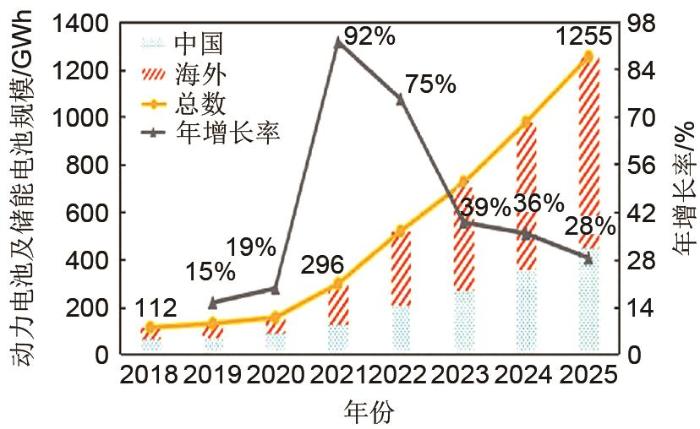
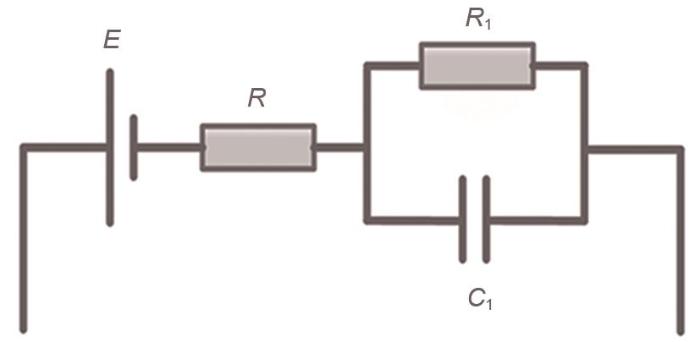
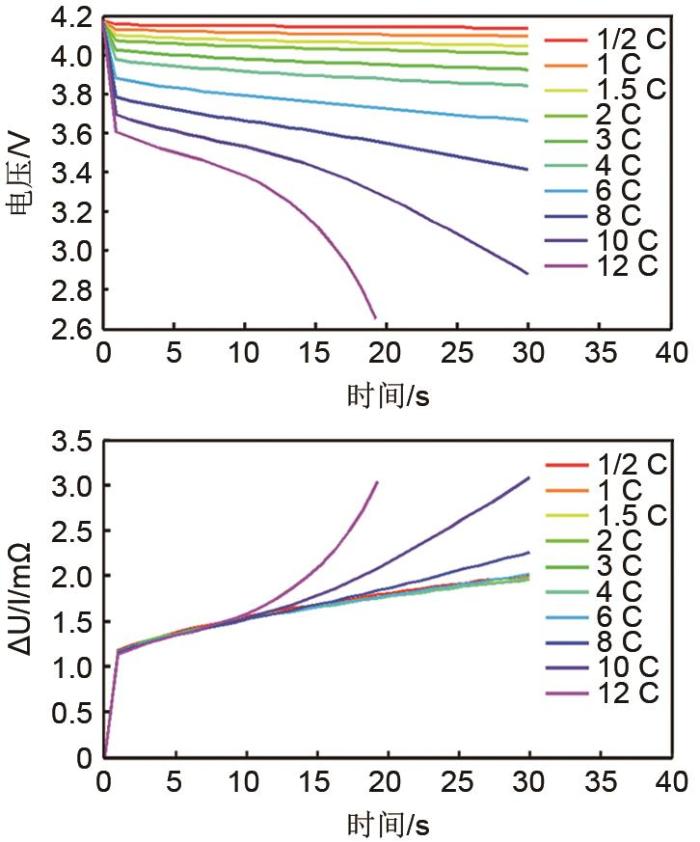
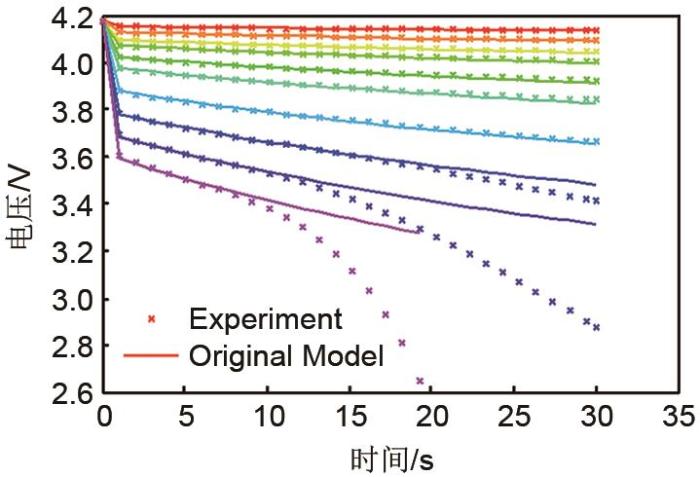
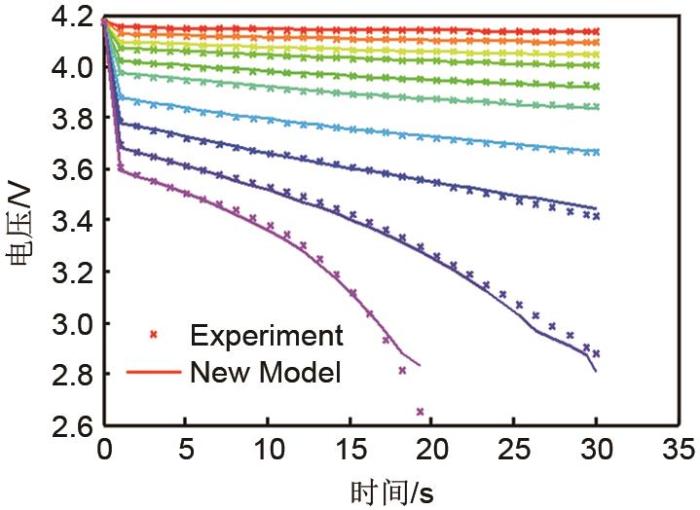
With the advancement of energy transition in China, using power batteries is rising yearly. The problem of battery safety has gradually come to the fore. In the battery management system (BMS), the equivalent circuit model (ECM) is the core of its work to ensure safe and stable operation. The current battery model in the BMS is mainly linear, which is limited by the computational volume and the computing power of the chip, which cannot reasonably and practically express the nonlinear characteristics of the battery under extreme operating conditions, such as high power. To address this problem, herein, from the perspective of available power, pulse discharge experiments are conducted on the battery at different multipliers to analyze the nonlinear characteristics of the internal resistance of the battery, improve the equivalent circuit model of the battery, and establish the variation of impedance with current under high multiplier conditions. The error of the improved impedance model is 1.74%, considerably smaller than the 8% of the old model. The results show an improved accuracy compared with the traditional equivalent circuit model, and the calculated computational volume is smaller than that of the P2D model, which is expected to be used in the online simulation calculation of the battery model in BMS to avoid over-power discharge of power batteries and improve the safety of battery use.
Keywords:lithium ion battery
;
model parameters
;
battery impedance
;
impedance model optimization
;
rate characteristic experiment
;
active management
LI Xinyu. Optimization of an impedance model for power Li-ion batteries based on a large multiplier current pulse[J]. Energy Storage Science and Technology, 2023, 12(5): 1686-1694
BMS主要通过电池模型对电池的荷电状态(State of charge,SOC)、健康状态(State of health,SOH)、功率状态(State of power,SOP)、剩余能量状态(State of energy,SOE)等状态量进行估计[13-17]。由于SOP需要估计电池可以放出的功率,需要更加精确的模型,以确定在不同电流下电池端电压的情况,从而分析计算电池的许用功率值[14, 18]。
HUO Z X, WANG M X, SHI L N, et al. Analysis and prospect of development status of electric cars and charging equipment[J]. Rural Power Management, 2023(1): 28-30.
LIN H, CAO K Y. The Current situation and development of electric bicycle battery market in China in 2020[J]. Chinese Battery Industry, 2020, 24(1): 47-49.
CAMARGOS P H, DOS SANTOS P H J, DOS SANTOS I R, et al. Perspectives on Li-ion battery categories for electric vehicle applications: A review of state of the art[J]. International Journal of Energy Research, 2022, 46(13): 19258-19268.
HE J. Present situation, problems and suggestions on the development of battery energy storage power stations in China[J]. New Energy Technology, 2021(6): 30-33.
SUN Y T, ZONG M R, HUANG Q, et al. Study on overcharge heat transfer of Ferrous lithium phosphate single battery with soft package and hard shell[J]. Electric Power Engineering Technology, 2020, 39(6): 191-198, 219.
ZHU W P, CHEN G W, WEI Z N, et al. Parameter identification of lithium battery based on VFFRLS algorithm[J]. Electric Power Engineering Technology, 2023, 42(1): 226-233.
TANG C Y, HAN H C, SHI M M, et al. Research on SOC estimation method of energy storage battery system based on DEKF[J]. Electric Power Engineering Technology, 2021, 40(3): 7-14.
CHEN C N, CHEN B L, WANG T, et al. Battery health assessment and life prediction in battery management system[C]//2022 3rd International Conference on Electronic Communication and Artificial Intelligence (IWECAI). January 14-16, 2022, Zhuhai, China. IEEE, 2022: 87-90.
REN D S, LU L G, SHEN P, et al. Battery remaining discharge energy estimation based on prediction of future operating conditions[J]. Journal of Energy Storage, 2019, 25: 100836.
OUYANG M G, LIU G M, LU L G, et al. Enhancing the estimation accuracy in low state-of-charge area: A novel onboard battery model through surface state of charge determination[J]. Journal of Power Sources, 2014, 270: 221-237.
XIONG R, HE H W, SUN F C, et al. Model-based state of charge and peak power capability joint estimation of lithium-ion battery in plug-in hybrid electric vehicles[J]. Journal of Power Sources, 2013, 229: 159-169.
ADAIKKAPPAN M, SATHIYAMOORTHY N. Modeling, state of charge estimation, and charging of lithium‐ion battery in electric vehicle: A review[J]. International Journal of Energy Research, 2021, 46(5): 2141-2165.
SALDAÑA G, MARTÍN J, ZAMORA I, et al. Analysis of the current electric battery models for electric vehicle simulation[J]. Energies, 2019, 12(14): 2750.
WAAG W, FLEISCHER C, SAUER D U. Critical review of the methods for monitoring of lithium-ion batteries in electric and hybrid vehicles[J]. Journal of Power Sources, 2014, 258: 321-339.
LIU C H, HU M H, JIN G Q, et al. State of power estimation of lithium-ion battery based on fractional-order equivalent circuit model[J]. Journal of Energy Storage, 2021, 41: 102954.
MASTALI M, VAZQUEZ-ARENAS J, FRASER R, et al. Battery state of the charge estimation using Kalman filtering[J]. Journal of Power Sources, 2013, 239: 294-307.
TELMASRE T, GOSWAMI N, CONCEPCIÓN A, et al. Impedance response simulation strategies for lithium-ion battery models[J]. Current Opinion in Electrochemistry, 2022, 36: 101140.
FLEISCHER C, WAAG W, BAI Z O, et al. Adaptive on-line state-of-available-power prediction of lithium-ion batteries[J]. Journal of Power Electronics, 2013, 13(4): 516-527.
XIONG R, HONGWEN H, SUN F C, et al. Online estimation of peak power capability of Li-ion batteries in electric vehicles by a hardware-in-loop approach[J]. Energies, 2012, 5(5): 1455-1469.
WAAG W, FLEISCHER C, SAUER D U. On-line estimation of lithium-ion battery impedance parameters using a novel varied-parameters approach[J]. Journal of Power Sources, 2013, 237: 260-269.
... BMS主要通过电池模型对电池的荷电状态(State of charge,SOC)、健康状态(State of health,SOH)、功率状态(State of power,SOP)、剩余能量状态(State of energy,SOE)等状态量进行估计[13-17].由于SOP需要估计电池可以放出的功率,需要更加精确的模型,以确定在不同电流下电池端电压的情况,从而分析计算电池的许用功率值[14, 18]. ...
1
... BMS主要通过电池模型对电池的荷电状态(State of charge,SOC)、健康状态(State of health,SOH)、功率状态(State of power,SOP)、剩余能量状态(State of energy,SOE)等状态量进行估计[13-17].由于SOP需要估计电池可以放出的功率,需要更加精确的模型,以确定在不同电流下电池端电压的情况,从而分析计算电池的许用功率值[14, 18]. ...
1
... BMS主要通过电池模型对电池的荷电状态(State of charge,SOC)、健康状态(State of health,SOH)、功率状态(State of power,SOP)、剩余能量状态(State of energy,SOE)等状态量进行估计[13-17].由于SOP需要估计电池可以放出的功率,需要更加精确的模型,以确定在不同电流下电池端电压的情况,从而分析计算电池的许用功率值[14, 18]. ...
1
... BMS主要通过电池模型对电池的荷电状态(State of charge,SOC)、健康状态(State of health,SOH)、功率状态(State of power,SOP)、剩余能量状态(State of energy,SOE)等状态量进行估计[13-17].由于SOP需要估计电池可以放出的功率,需要更加精确的模型,以确定在不同电流下电池端电压的情况,从而分析计算电池的许用功率值[14, 18]. ...
... BMS主要通过电池模型对电池的荷电状态(State of charge,SOC)、健康状态(State of health,SOH)、功率状态(State of power,SOP)、剩余能量状态(State of energy,SOE)等状态量进行估计[13-17].由于SOP需要估计电池可以放出的功率,需要更加精确的模型,以确定在不同电流下电池端电压的情况,从而分析计算电池的许用功率值[14, 18]. ...
1
... BMS主要通过电池模型对电池的荷电状态(State of charge,SOC)、健康状态(State of health,SOH)、功率状态(State of power,SOP)、剩余能量状态(State of energy,SOE)等状态量进行估计[13-17].由于SOP需要估计电池可以放出的功率,需要更加精确的模型,以确定在不同电流下电池端电压的情况,从而分析计算电池的许用功率值[14, 18]. ...