储能科学与技术 ›› 2025, Vol. 14 ›› Issue (11): 4184-4198.doi: 10.19799/j.cnki.2095-4239.2025.0496
金宇玄1( ), 周权1(), 周琳2(), 高腾1, 李子杰1, 王琰2, 卢俊龙1
收稿日期:2025-05-27
修回日期:2025-06-16
出版日期:2025-11-28
发布日期:2025-11-24
通讯作者:
周权,周琳
E-mail:george_jyx@163.com;zhouquan@ioply.cn;lzhou@iphy.ac.cn
作者简介:金宇玄(1996—),男,硕士,工程师,研究方向为钠离子电池正极材料,E-mail:george_jyx@163.com;
基金资助:
Yuxuan JIN1(), Quan ZHOU1(), Lin ZHOU2(), Teng GAO1, Zijie LI1, Yan WANG2, Junlong LU1
Received:2025-05-27
Revised:2025-06-16
Online:2025-11-28
Published:2025-11-24
Contact:
Quan ZHOU, Lin ZHOU
E-mail:george_jyx@163.com;zhouquan@ioply.cn;lzhou@iphy.ac.cn
摘要:
NASICON型聚阴离子正极材料作为最具潜力的钠电正极材料,凭借优异的循环性能和倍率性能得到产业界的广泛关注,其具有电压相对较高、制备工艺简单、反应动力学优异及热力学稳定等诸多优势,目前部分聚阴离子磷酸盐材料已经规模化生产,但一些磷酸盐材料的技术瓶颈阻碍了材料的商业化应用。本文首先根据不同过渡金属元素的特点对该类正极材料进行分类,说明了NASICON型磷酸盐正极材料面临着成本高昂、框架结构不稳定、环境不友好等诸多挑战,从材料构效关系、原材料成本、元素掺杂和界面调控等方面出发,介绍材料特性、综述研究进展;分析表明,激活更多电子反应对、优化材料反应动力学,以及开发更具性价比的正极材料是NASICON型磷酸盐材料的主要发展方向,而在Ti、V、Cr、Mn、Fe等过渡金属元素中,Mn基磷酸盐的高电压和低成本的优势在NASICON型磷酸盐材料中展现出更突出的价值,针对Mn基材料在循环过程中容易引发姜泰勒效应而导致材料发生晶格畸变及容量衰减,本文综述了Mn基磷酸盐材料的优化方向,助推 NASICON型聚阴离子正极材料的商业化进程。
中图分类号:
金宇玄, 周权, 周琳, 高腾, 李子杰, 王琰, 卢俊龙. 钠离子电池NASICON型磷酸盐正极材料研究进展[J]. 储能科学与技术, 2025, 14(11): 4184-4198.
Yuxuan JIN, Quan ZHOU, Lin ZHOU, Teng GAO, Zijie LI, Yan WANG, Junlong LU. Research progress of NASICON-type phosphate cathode materials for sodium-ion batteries[J]. Energy Storage Science and Technology, 2025, 14(11): 4184-4198.
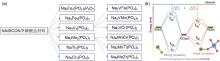
图1
(a) 主要NASICON型磷酸盐分类,(b) 磷酸盐离子和层状氧化物的化学键合与氧化还原电位关系示意图[10]"

图2
(a) 中间相Na2V2(PO4)3 的结构示意图[14],(b) NVP中的Na离子迁移路径[15],(c) NVP@Al的循环和倍率性能[18],(d) 通过溶剂热法制备的花状NVP/C[16]"

图3
(a) NFPP||Bi合金全电池的低温性能[29],(b) 静电纺丝法制备的NFPP嵌入一维碳纳米带复合材料[31]"
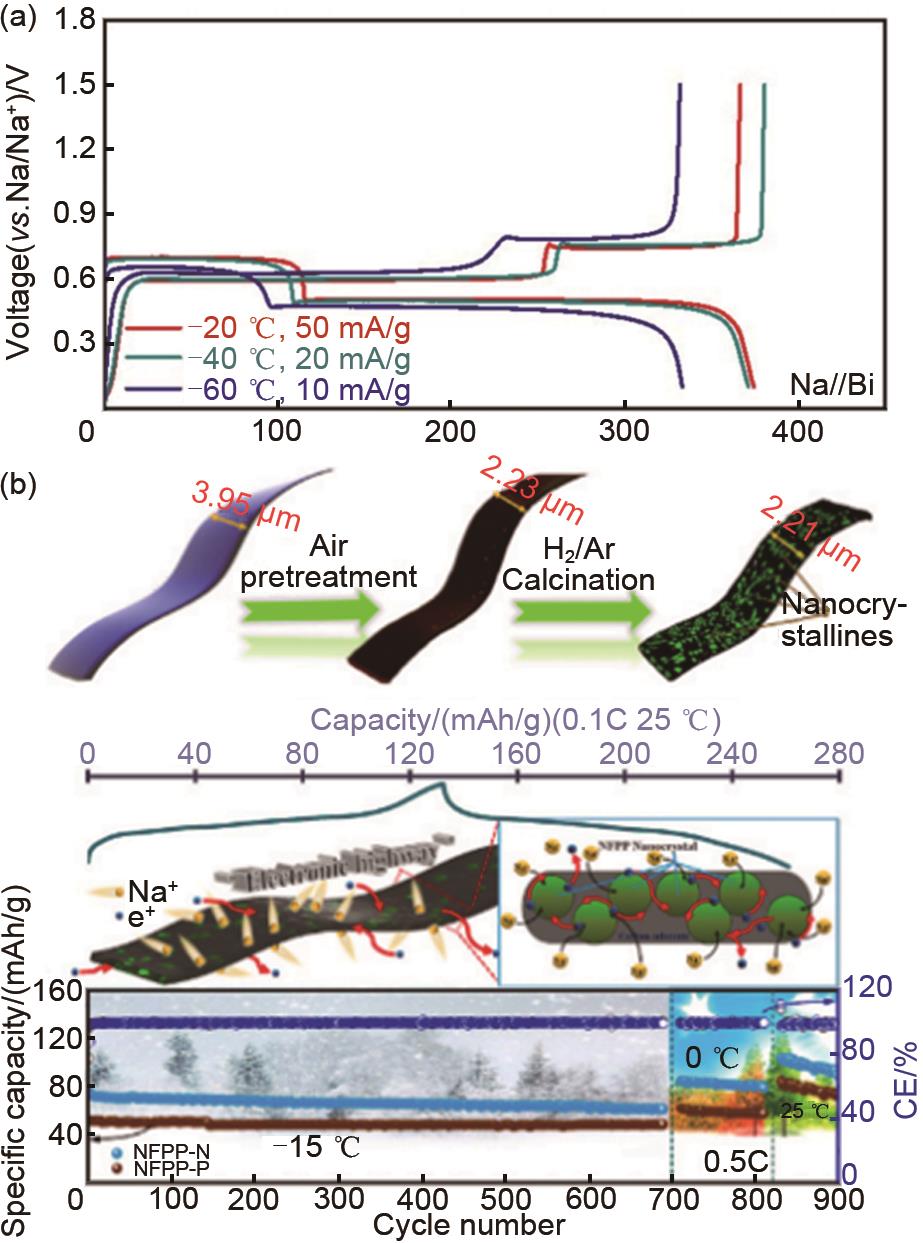
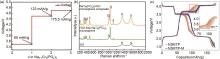
图4
(a) 脱嵌电子数量对Na3Cr2(PO4)3 材料电压和比容量的影响[33],(b)合成的NaTi2(PO4)3/rGO材料的Raman光谱[35],(c) Na3MnTi(PO4)3 材料在循环过程中因姜泰勒效应导致的容量衰减[36]"
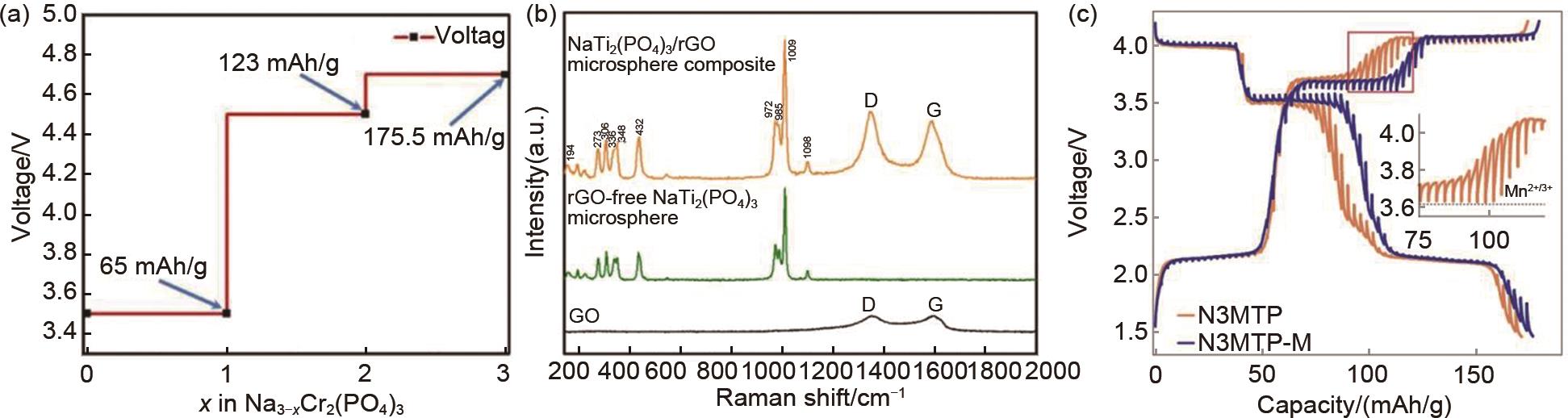
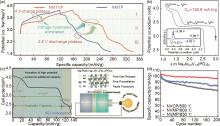
图5
(a) Mn-Na混排现象引起的电压滞后现象[45],(b) Al离子掺杂激活V4+/V5+ 电压平台[38],(c) Fe离子掺杂激活V4+/V5+ 电压平台[39],(d) 高熵掺杂改性的NVP材料循环性能[46]"
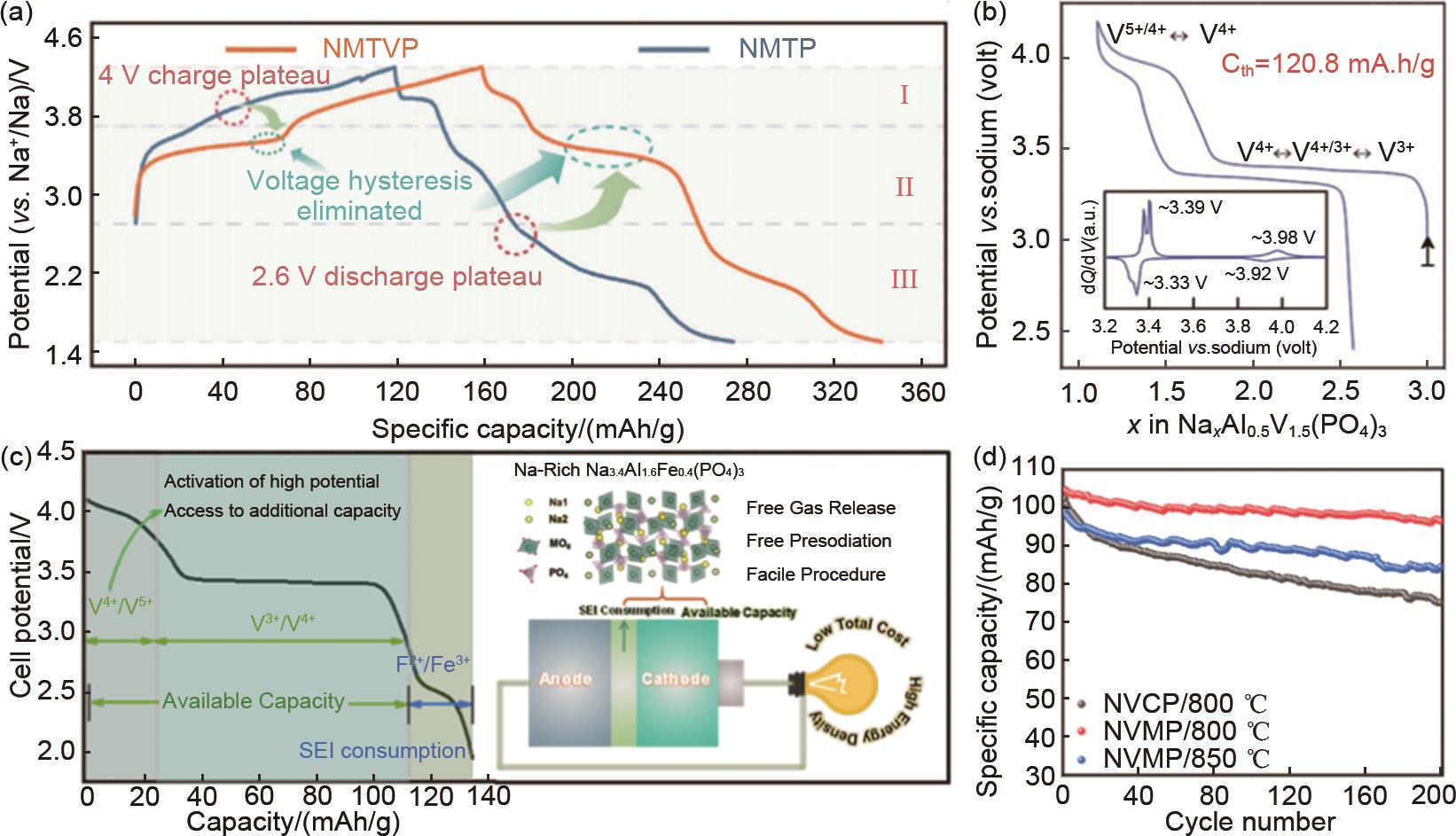
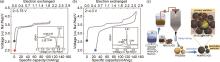
图6
(a) 2~3.75 V下循环电压-容量及氧化还原电位曲线,(b) 2~4.3 V下循环电压-容量及氧化还原电位曲线[52],(c) 喷雾干燥法制备的NVMP@rGO复合材料[54]"
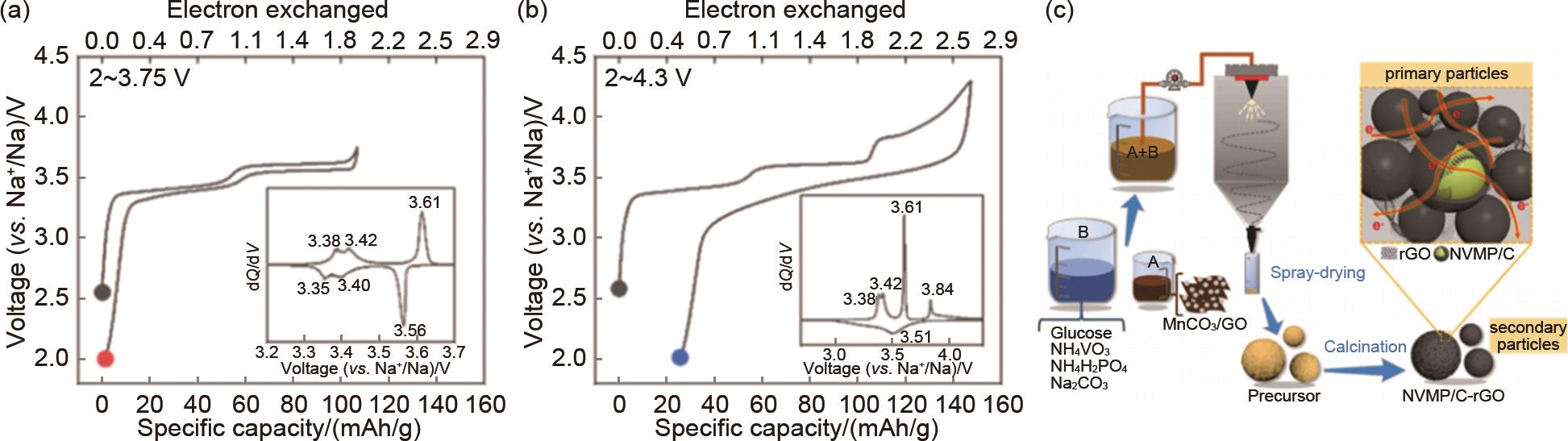
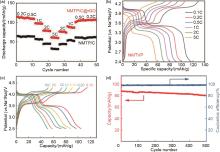
图7
(a) NMTP/C@rGO与NMTP/C的倍率性能[64],(b) NMTVP的倍率性能[45],(c) NMZP@C@rGO的倍率性能,(d) NMZP的循环性能[67]"
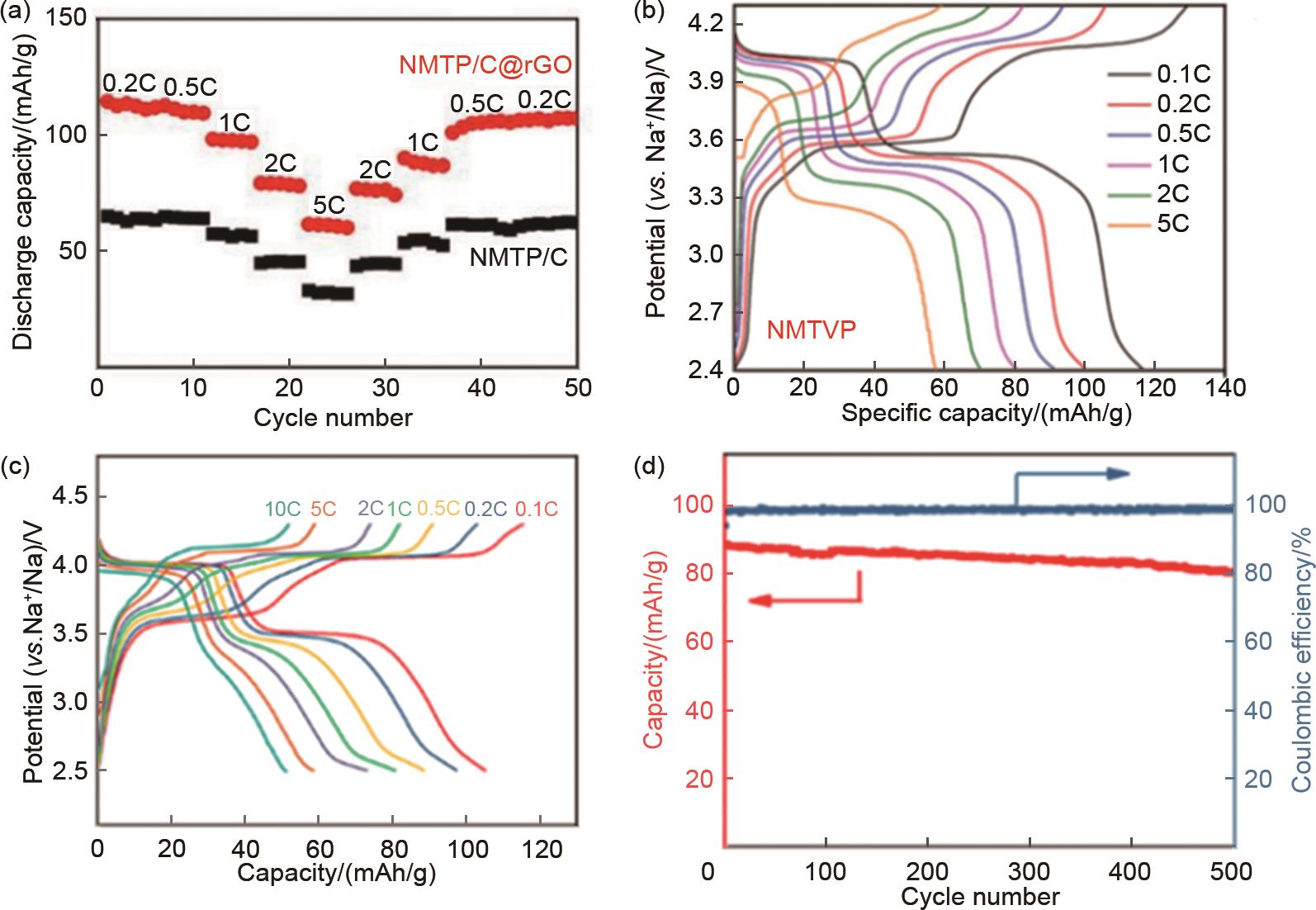
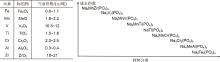
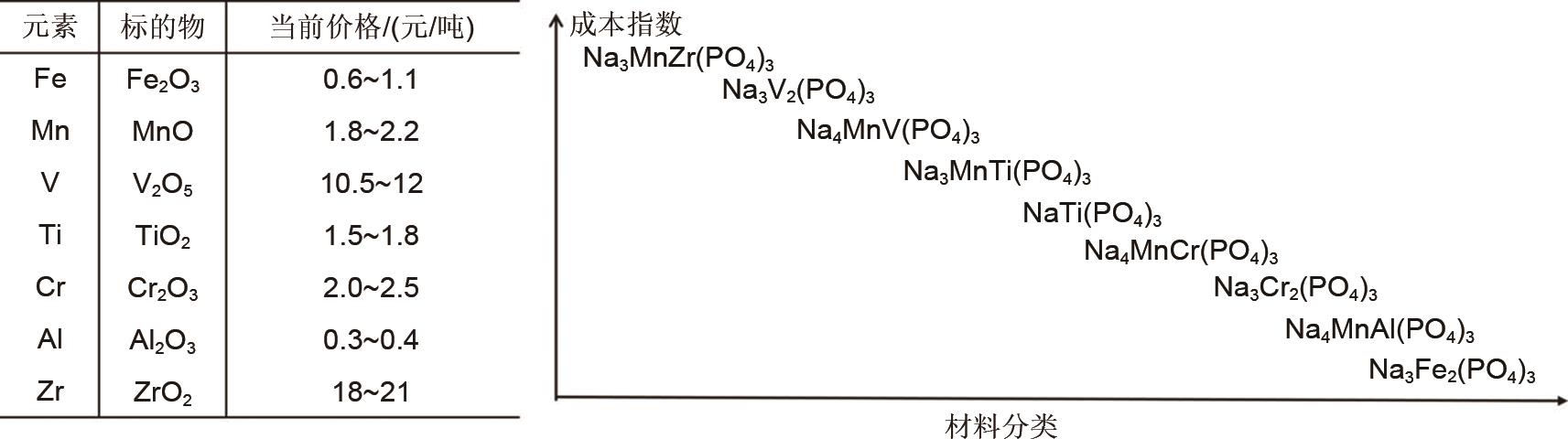
图8
代表性NASICON型磷酸盐化合物的成本分析"
| [1] | PAN H L, HU Y S, CHEN L Q. Room-temperature stationary sodium-ion batteries for large-scale electric energy storage[J]. Energy & Environmental Science, 2013, 6(8): 2338-2360. DOI: 10.1039/C3EE40847G. |
| [2] | QIAN J F, WU C, CAO Y L, et al. Prussian blue cathode materials for sodium-ion batteries and other ion batteries[J]. Advanced Energy Materials, 2018, 8(17): 1702619. DOI: 10.1002/aenm. 201702619. |
| [3] | XU L G, FENG X Y, JIA W B, et al. Recent advances and challenges of inverted lead-free tin-based perovskite solar cells[J]. Energy & Environmental Science, 2021, 14(8): 4292-4317. DOI: 10.1039/D1EE00890K. |
| [4] | YABUUCHI N, KOMABA S. Recent research progress on iron- and manganese-based positive electrode materials for rechargeable sodium batteries[J]. Science and Technology of Advanced Materials, 2014, 15(4): DOI: 10.1088/1468-6996/15/4/043501. |
| [5] | GOODENOUGH J B. NASICON I structure and conductivity[J]. Solid State Ionics, 1983, 9: 793-794. DOI: 10.1016/0167-2738(83)90088-7. |
| [6] | FEI W B, SUI Y L, WANG Y A, et al. Regulating Na/Mn antisite defects and reactivating anomalous jahn-teller behavior for Na4Fe1.5Mn1.5(PO4)2(P2O7) cathode material with superior performance[J]. ACS Nano, 2025, 19(8): 8303-8315. DOI: 10.1021/acsnano. 4c18614. |
| [7] | HAMEED A S, OHARA M, KUBOTA K, et al. A phosphite-based layered framework as a novel positive electrode material for Na-ion batteries[J]. Journal of Materials Chemistry A, 2021, 9(8): 5045-5052. DOI: 10.1039/D0TA10517A. |
| [8] | LIANG L W, LI X Y, ZHAO F, et al. High-rate cathodes: Construction and operating mechanism of high-rate Mo-doped Na3V2(PO4)3@C nanowires toward practicable wide-temperature-tolerance Na-ion and hybrid Li/Na-ion batteries[J]. Advanced Energy Materials, 2021, 11(21): 2170079. DOI: 10.1002/aenm.202170079. |
| [9] | LI F, ZHU Y E, SHENG J, et al. GO-induced preparation of flake-shaped Na3V2(PO4)3@rGO as high-rate and long-life cathodes for sodium-ion batteries[J]. Journal of Materials Chemistry A, 2017, 5(48): 25276-25281. DOI: 10.1039/C7TA07943E. |
| [10] | PARK S, WANG Z L, CHOUDHARY K, et al. Obtaining V2(PO4)3 by sodium extraction from single-phase NaxV2(PO4)3 (1<x<3) positive electrode materials[J]. Nature Materials, 2024, 24(2): 234-242. DOI: 10.1038/s41563-024-02023-7. |
| [11] | SINGH B, WANG Z L, PARK S, et al. A chemical map of NaSICON electrode materials for sodium-ion batteries[J]. Journal of Materials Chemistry A, 2021, 9(1): 281-292. DOI: 10.1039/d0ta 10688g. |
| [12] | LI S H, ZHOU W, LIU F Y, et al. Mitigating long range Jahn-Teller ordering to stabilize Mn redox reaction in biphasic layered sodium oxide[J]. Advanced Energy Materials, 2025, 15(10): 2403955. DOI: 10.1002/aenm.202403955. |
| [13] | BEN YAHIA M, VERGNET J, SAUBANÈRE M, et al. Unified picture of anionic redox in Li/Na-ion batteries[J]. Nature Materials, 2019, 18(5): 496-502. DOI: 10.1038/s41563-019-0318-3. |
| [14] | PARK S, WANG Z L, DENG Z Y, et al. Crystal structure of Na2V2(PO4)3, an intriguing phase spotted in the Na3V2(PO4)3-Na1V2(PO4)3 system[J]. Chemistry of Materials, 2022, 34(1): 451-462. DOI: 10. 1021/acs.chemmater.1c04033. |
| [15] | JIAN Z L, HAN W Z, LU X, et al. Superior electrochemical performance and storage mechanism of Na3V2(PO4)3 cathode for room-temperature sodium-ion batteries[J]. Advanced Energy Materials, 2013, 3(2): 156-160. DOI: 10.1002/aenm.201200558. |
| [16] | SU Q, ZHOU Y F, ZHU J, et al. Nanoflake-assembled hierarchical Na3V2(PO4)3@C microspheres for ultrafast and highly durable sodium storage[J]. ACS Applied Energy Materials, 2023, 6(19): 10128-10136. DOI: 10.1021/acsaem.3c01871. |
| [17] | ZHU Q, WANG M, NAN B, et al. Core/shell nanostructured Na3V2(PO4)3/C/TiO2 composite nanofibers as a stable anode for sodium-ion batteries[J]. Journal of Power Sources, 2017, 362: 147-159. DOI: 10.1016/j.jpowsour.2017.07.004. |
| [18] | DONG L, LIU R X, FENG J M, et al. Improved high-rate performance of Na3V2(PO4)3 with an atomic layer deposition-generated Al2O3 layer as a cathode material for sodium-ion batteries[J]. Materials Letters, 2017, 205: 75-78. DOI: 10.1016/j.matlet.2017.06.067. |
| [19] | ZENG J, YANG Y, LAI S B, et al. A promising high-voltage cathode material based on mesoporous Na3V2(PO4)3/C for rechargeable magnesium batteries[J]. Chemistry-A European Journal, 2017, 23(66): 16898-16905. DOI: 10.1002/chem.201704303. |
| [20] | YAO X H, ZHU Z X, LI Q, et al. 3.0 V high energy density symmetric sodium-ion battery: Na4V2(PO4)3∥Na3V2(PO4)3[J]. ACS Applied Materials & Interfaces, 2018, 10(12): 10022-10028. DOI: 10.1021/acsami.7b16901. |
| [21] | XU M L, ZHANG F X, ZHANG Y H, et al. Controllable synthesis of a Na-enriched Na4V2(PO4)3 cathode for high-energy sodium-ion batteries: A redox-potential-matched chemical sodiation approach[J]. Chemical Science, 2023, 14(44): 12570-12581. DOI: 10.1039/D3SC 03498D. |
| [22] | YANG Y, XU G R, TANG A P, et al. Na3V2(PO4)3-decorated Na3V2(PO4)2F3 as a high-rate and cycle-stable cathode material for sodium ion batteries[J]. RSC Advances, 2024, 14(17): 11862-11871. DOI: 10.1039/D4RA01653J. |
| [23] | HU P, WANG X F, WANG T S, et al. Boron substituted Na3V2(P1- xBxO4)3 cathode materials with enhanced performance for sodium-ion batteries[J]. Advanced Science, 2016, 3(12): 1600112. DOI: 10.1002/advs.201600112. |
| [24] | WANG D, WU Y B, LV J M, et al. Carbon encapsulated maricite NaFePO4 nanoparticles as cathode material for sodium-ion batteries[J]. Colloids and Surfaces A: Physicochemical and Engineering Aspects, 2019, 583: 123957. DOI: 10.1016/j.colsurfa. 2019.123957. |
| [25] | CAO Y J, LIU Y, ZHAO D Q, et al. Highly stable Na3Fe2(PO4)3@Hard carbon sodium-ion full cell for low-cost energy storage[J]. ACS Sustainable Chemistry & Engineering, 2020, 8(3): 1380-1387. DOI: 10.1021/acssuschemeng.9b05098. |
| [26] | KIM H, PARK I, LEE S, et al. Understanding the electrochemical mechanism of the new iron-based mixed-phosphate Na4Fe3(PO4)2(P2O7) in a Na rechargeable battery[J]. Chemistry of Materials, 2013, 25(18): 3614-3622. DOI: 10.1021/cm4013816. |
| [27] | SENTHILKUMAR B, RAMBABU A, MURUGESAN C, et al. Iron-based mixed phosphate Na4Fe3(PO4)2P2O7 thin films for sodium-ion microbatteries[J]. ACS Omega, 2020, 5(13): 7219-7224. DOI: 10.1021/acsomega.9b03835. |
| [28] | HUANG J R, ZHANG Z H, CHEN D Q, et al. Spray-drying synthesis of Na4Fe3(PO4)2P2O7@CNT cathode for ultra-stable and high-rate sodium-ion batteries[J]. Molecules, 2025, 30(3): 753. DOI: 10.3390/molecules30030753. |
| [29] | LI Z, ZHANG Y, ZHANG J H, et al. Sodium-ion battery with a wide operation-temperature range from -70 to 100 ℃[J]. Angewandte Chemie International Edition, 2022, 61(13): e202116930. DOI: 10. 1002/anie.202116930. |
| [30] | ZHAO A L, YUAN T C, LI P, et al. A novel Fe-defect induced pure-phase Na4Fe2.91(PO4)2P2O7 cathode material with high capacity and ultra-long lifetime for low-cost sodium-ion batteries[J]. Nano Energy, 2022, 91: 106680. DOI: 10.1016/j.nanoen.2021.106680. |
| [31] | ZHANG J H, TANG L B, ZHANG Y, et al. Polyvinylpyrrolidone assisted synthesized ultra-small Na4Fe3(PO4)2(P2O7) particles embedded in 1D carbon nanoribbons with enhanced room and low temperature sodium storage performance[J]. Journal of Power Sources, 2021, 498: 229907. DOI: 10.1016/j.jpowsour. 2021.229907. |
| [32] | SUBAŞı Y, ALTENSCHMIDT L, LINDGREN F, et al. Synthesis and characterization of a crystalline Na4Fe3(PO4)2(P2O7) cathode material for sodium-ion batteries[J]. Journal of Materials Chemistry A, 2024, 12(35): 23506-23517. DOI: 10.1039/D4TA 03554B. |
| [33] | MAMOOR M, LIAN R Q, WANG D S, et al. Identification of the structural, electronic properties, and ionic diffusion kinetics of Na3Cr2(PO4)3 by first-principles calculations[J]. Electrochimica Acta, 2021, 379: 138157. DOI: 10.1016/j.electacta.2021.138157. |
| [34] | KAWAI K, ASAKURA D, NISHIMURA S I, et al. Stabilization of a 4.5 V Cr4+/Cr3+ redox reaction in NASICON-type Na3Cr2(PO4)3 by Ti substitution[J]. Chemical Communications, 2019, 55(91): 13717-13720. DOI: 10.1039/C9CC04860J. |
| [35] | ROH H K, KIM M S, CHUNG K Y, et al. A chemically bonded NaTi2(PO4)3/rGO microsphere composite as a high-rate insertion anode for sodium-ion capacitors[J]. Journal of Materials Chemistry A, 2017, 5(33): 17506-17516. DOI: 10.1039/C7TA05252A. |
| [36] | WANG Y A, SUI Y L, XIAO Z, et al. Inner/interface engineered iron/manganese-based mixed phosphate cathode with high energy density and ultra-long cycle life for sodium-ion batteries[J]. Advanced Functional Materials, 2025, 35(28): 2500290. DOI: 10.1002/adfm.202500290. |
| [37] | LIU Y, RONG X H, BAI R, et al. Identifying the intrinsic anti-site defect in manganese-rich NASICON-type cathodes[J]. Nature Energy, 2023, 8(10): 1088-1096. DOI: 10.1038/s41560-023-01301-z. |
| [38] | LALÈRE F, SEZNEC V, COURTY M, et al. Improving the energy density of Na3V2(PO4)3-based positive electrodes through V/Al substitution[J]. Journal of Materials Chemistry A, 2015, 3(31): 16198-16205. DOI: 10.1039/C5TA03528G. |
| [39] | XU C L, ZHAO J M, WANG Y A, et al. Reversible activation of V4+/V5+ redox couples in NASICON phosphate cathodes[J]. Advanced Energy Materials, 2022, 12(25): 2200966. DOI: 10.1002/aenm. 202200966. |
| [40] | MAI B, XING B Y, YUE Y F, et al. Cr-doped Na3V2(PO4)3@C enables high-capacity with V2+/V5+ reaction and stable sodium storage[J]. Journal of Materials Science & Technology, 2023, 165: 1-7. DOI: 10.1016/j.jmst.2023.05.005. |
| [41] | BAG S, MURARKA H, ZHOU C T, et al. Understanding the Na-ion storage mechanism in Na3+ xV2- xMx(PO4)3 (M = Ni2+, Co2+, Mg2+; x = 0.1-0.5) cathodes[J]. ACS Applied Energy Materials, 2020, 3(9): 8475-8486. DOI: 10.1021/acsaem.0c01118. |
| [42] | INOISHI A, YOSHIOKA Y, ZHAO L W, et al. Improvement in the energy density of Na3V2(PO4)3 by Mg substitution[J]. ChemElectroChem, 2017, 4(11): 2755-2759. DOI: 10.1002/celc. 201700540. |
| [43] | AHSAN M T, QIU D P, ALI Z, et al. Unraveling the fast Na diffusion kinetics of NASICON at high voltage via high entropy for sodium-ion battery[J]. Advanced Energy Materials, 2024, 14(4): 2302733. DOI: 10.1002/aenm.202302733. |
| [44] | LIN B H, WU X, HE X J, et al. High-entropy doping in NASICON cathodes: Activating the V4+/V5+ redox couple and inducing a reversible single solid-solution phase reaction for advanced sodium ion batteries[J]. Journal of Colloid and Interface Science, 2025, 690: 137299. DOI: 10.1016/j.jcis.2025.137299. |
| [45] | ZHANG H, GU Z Y, WANG X T, et al. Electronic confinement-restrained Mn·Na anti-site defects in sodium-rich phosphates toward multi-electron transfer and high energy efficiency[J]. Advanced Materials, 2024, 36(47): 2410797. DOI: 10.1002/adma.202410797. |
| [46] | WU X N, LI Z K, ZHANG J C, et al. Insight into highly reversible multielectron V3+/V4+/V5+ reaction of high-entropy doped NASICON cathode for sodium ion batteries[J]. ACS Applied Materials & Interfaces, 2025, 17(8): 12227-12236. DOI: 10.1021/acsami.4c21356. |
| [47] | XIE P X, ZHAO Q Y, DONG H J, et al. Reversible V4+/V5+ redox in Na4VFe(PO4)3 cathode for high-power sodium-ion batteries[J]. Chemical Engineering Journal, 2025, 509: 161209. DOI: 10.1016/j.cej.2025.161209. |
| [48] | ZHU L, WANG M M, LIANG K, et al. Achieving high capacity and ultra-stable sodium storage of Na2TiV(PO4)3 cathode by integrated lattice regulation and surface modification[J]. Journal of Energy Chemistry, 2025, 103: 793-802. DOI: 10.1016/j.jechem.2024. 10.052. |
| [49] | RUBIO S, LIU R, LIU X S, et al. Exploring the high-voltage Mg2+/Na+ co-intercalation reaction of Na3VCr(PO4)3 in Mg-ion batteries[J]. Journal of Materials Chemistry A, 2019, 7(30): 18081-18091. DOI: 10.1039/C9TA05608D. |
| [50] | PARK J S, KIM J, JO J H, et al. Role of the Mn substituent in Na3V2(PO4)3 for high-rate sodium storage[J]. Journal of Materials Chemistry A, 2018, 6(34): 16627-16637. DOI: 10.1039/C8TA 06162A. |
| [51] | ZHOU Y F, GUO S, LI S, et al. Enabling high-performance Na4MnV(PO4)3 cathode via synergetic strategy of carbon encapsulation and nanoengineering[J]. Journal of Power Sources, 2022, 521: 230974. DOI: 10.1016/j.jpowsour.2022. 230974. |
| [52] | PARK S, CHOTARD J N, CARLIER D, et al. Irreversible electrochemical reaction at high voltage induced by distortion of Mn and V structural environments in Na4MnV(PO4)3[J]. Chemistry of Materials, 2023, 35(8): 3181-3195. DOI: 10.1021/acs.chemmater. 2c03787. |
| [53] | SOUNDHARRAJAN V, ALFAZA G, ARIFIADI A, et al. Na3.5(MnVFeTi)0.5(PO4)3: A multi-transition-metal-ion-engineered NASICON-type cathodes for sodium ion batteries[J]. Batteries & Supercaps, 2025, 8(3): e202400526. DOI: 10.1002/batt.202400526. |
| [54] | CUI G J, DONG Q Y, WANG Z Z, et al. Achieving highly reversible and fast sodium storage of Na4VMn(PO4)3/C-rGO composite with low-fraction rGO via spray-drying technique[J]. Nano Energy, 2021, 89: 106462. DOI: 10.1016/j.nanoen.2021. 106462. |
| [55] | GHOSH S, BARMAN N, MAZUMDER M, et al. High capacity and high-rate NASICON-Na3.75V1.25Mn0.75(PO4)3 cathode for Na-ion batteries via modulating electronic and crystal structures[J]. Advanced Energy Materials, 2020, 10(6): 1902918. DOI: 10.1002/aenm.201902918. |
| [56] | AHSAN M T, ALI Z, QIU D P, et al. A strategy to mitigate jahn teller effect of Mn-rich NASICON framework for sodium-ion batteries[J]. Small, 2024, 20(43): 2402275. DOI: 10.1002/smll. 202402275. |
| [57] | LI W, LI J P, LI R R, et al. Study on sodium storage properties of manganese-doped sodium vanadium phosphate cathode materials[J]. Battery Energy, 2023, 2(2): 20220042. DOI: 10.1002/bte2.20220042. |
| [58] | GHOSH S, BARMAN N, SENGUTTUVAN P. High capacity and high rate nasicon NaxV(Mn/Mg/Al)(PO4)3 cathodes for Na-ion batteries[J]. ECS Meeting Abstracts, 2021, MA2021-01(4): 255. DOI: 10.1149/ma2021-014255mtgabs. |
| [59] | XU C L, ZHAO J M, WANG E H, et al. A novel NASICON-typed Na4VMn0.5Fe0.5(PO4)3 cathode for high-performance Na-ion batteries[J]. Advanced Energy Materials, 2021, 11(22): 2100729. DOI: 10.1002/aenm.202100729. |
| [60] | YU S J, CHEN Y W, HUANG Y Y, et al. Na4MnCr(PO4)3 with a dual conductive network for sodium-ion batteries[J]. Advanced Sustainable Systems, 2025, 9(7): 2300233. DOI: 10.1002/adsu. 202300233. |
| [61] | LIU J H, WANG S, KAWAZOE Y, et al. Mechanisms of ionic diffusion and stability of the Na4MnCr(PO4)3 cathode[J]. ACS Materials Letters, 2022, 4(5): 860-867. DOI: 10.1021/acsmaterialslett. 2c00194. |
| [62] | CHEN Y, PENG P, SUN K Y, et al. Stabilizing NASICON-type Na4MnCr(PO4)3 by Ti-substitution toward a high-voltage cathode material for sodium ion batteries[J]. Journal of Colloid and Interface Science, 2024, 671: 385-393. DOI: 10.1016/j.jcis.2024. 05.130. |
| [63] | LI J, ZHAO X D, HE P G, et al. Stabilized multi-electron reactions in a high-energy Na4Mn0.9CrMg0.1(PO4)3 sodium-storage cathode enabled by the pinning effect[J]. Small, 2022, 18(31): 2202879. DOI: 10.1002/smll.202202879. |
| [64] | ZHU T, HU P, CAI C C, et al. Dual carbon decorated Na3MnTi(PO4)3: A high-energy-density cathode material for sodium-ion batteries[J]. Nano Energy, 2020, 70: 104548. DOI: 10.1016/j.nanoen.2020.104548. |
| [65] | QI Q, LI X D, LIANG J Q, et al. Effect of Zr4+ doping on the electrochemical properties of Na3MnTi(PO4)3/C cathode materials[J]. Journal of Electroanalytical Chemistry, 2023, 950: 117916. DOI: 10.1016/j.jelechem.2023.117916. |
| [66] | GAO H C, SEYMOUR I D, XIN S, et al. Na3MnZr(PO4)3: A high-voltage cathode for sodium batteries[J]. Journal of the American Chemical Society, 2018, 140(51): 18192-18199. DOI: 10.1021/jacs.8b11388. |
| [67] | MA X D, WU X H, LIU Y, et al. Toward a high-energy-density cathode with enhanced temperature adaptability for sodium-ion batteries: A case study of Na3MnZr(PO4)3 microspheres with embedded dual-carbon networks[J]. ACS Applied Materials & Interfaces, 2021, 13(18): 21390-21400. DOI: 10.1021/acsami. 1c03642. |
| [68] | PAREJIYA A, ESSEHLI R, AMIN R, et al. Na1+ xMnx/2Zr2- x/2(PO4)3 as a Li+ and Na+ super ion conductor for solid-state batteries[J]. ACS Energy Letters, 2021, 6(2): 429-436. DOI: 10.1021/acsenergylett. 0c02513. |
| [69] | ZHENG Y R, LIU J F, HUANG D, et al. Prepare and optimize NASICON-type Na4MnAl(PO4)3 as low cost cathode for sodium ion batteries[J]. Surfaces and Interfaces, 2022, 32: 102151. DOI: 10.1016/j.surfin.2022.102151. |
| [70] | ZHU Q, HU X L, TONG R, et al. Refining the electrochemical performance of Na4MnAl(PO4)3 cathode material by magnesium doping for sodium ion batteries[J]. Journal of Energy Storage, 2024, 92: 112258. DOI: 10.1016/j.est.2024.112258. |
| [71] | LIU Y, SUN C, LI Y, et al. Recent progress of Mn-based NASICON-type sodium ion cathodes[J]. Energy Storage Materials, 2023, 57: 69-80. DOI: 10.1016/j.ensm.2023.02.005. |
| [72] | DENG S P, SONG C R, LI S Y, et al. Rambutan-like Na4MnCr(PO4)3@C/CNTs as a high-energy-density cathode for sodium-ion batteries[J]. Solid State Ionics, 2024, 410: 116545. DOI: 10.1016/j.ssi.2024.116545. |
| [73] | LESLIE K, ABRAHAM J J, MACLENNAN H, et al. Reducing the rate of Mn dissolution in LiMn0.8Fe0.2PO4/graphite cells with mixed salt and low salt molarity electrolytes[J]. Journal of the Electrochemical Society, 2025, 172(4): 040515. DOI: 10.1149/1945-7111/adc951. |
| [74] | BENEDEK R. Role of disproportionation in the dissolution of Mn from lithium manganate spinel[J]. The Journal of Physical Chemistry C, 2017, 121(40): 22049-22053. DOI: 10.1021/acs.jpcc.7b05940. |
| [75] | FAN D S, WANG Y, ZHAO X D, et al. A novel NASICON-Na3.4MnV0.2Cr0.2Ti0.6(PO4)3 cathode with ultrahigh energy density and remarkable cycling stability toward practical Na-ion batteries[J]. Materials Today, 2025, 86: 63-73. DOI: 10.1016/j.mattod. 2025.03.010. |
| [76] | LU T M, SUN B X, DAI B H, et al. Efficient synthesis of NFPP sodium-ion battery cathode materials via a bimetallic iron source synergistic framework strategy[J]. Journal of Energy Storage, 2025, 107: 114976. DOI: 10.1016/j.est.2024.114976. |
| [77] | NGUYEN J, LEE Y, YANG Y. Suppression of high spin state of Mn for the improvement of Mn-based materials in rechargeable batteries[J]. Small, 2024, DOI: 10.1002/smll. 202410453. |
| [1] | 李秀春, 常永刚, 解炜, 李晓明, 陈成猛. 钠离子电池煤基炭负极可控制备:研究进展与展望[J]. 储能科学与技术, 2025, 14(9): 3373-3388. |
| [2] | 储玉喜, 马畅, 陈红光, 张少禹, 卓萍. 180 Ah钠离子电池热失控与产气特性分析[J]. 储能科学与技术, 2025, 14(9): 3611-3618. |
| [3] | 张新新, 岑官骏, 乔荣涵, 郝峻丰, 孙蔷馥, 郑博文, 谷宇皓, 田孟羽, 金周, 詹元杰, 闫勇, 贲留斌, 俞海龙, 刘燕燕, 周洪, 黄学杰. 锂电池百篇论文点评(2025.6.1—2025.7.31)[J]. 储能科学与技术, 2025, 14(9): 3229-3248. |
| [4] | 向靖宇, 钟伟, 程时杰, 谢佳. 助力钠电池储能:预钠化技术研究新进展[J]. 储能科学与技术, 2025, 14(8): 3051-3064. |
| [5] | 郝峻丰, 朱璟, 岑官骏, 乔荣涵, 张新新, 孙蔷馥, 田孟羽, 金周, 詹元杰, 闫勇, 贲留斌, 俞海龙, 刘燕燕, 周洪, 黄学杰. 锂电池百篇论文点评(2025.04.01—2025.05.31)[J]. 储能科学与技术, 2025, 14(7): 2884-2902. |
| [6] | 韩丹丹, 张武卫, 张亮, 王宗江. 核壳结构LiMn1-y Fe y PO4/C正极材料设计与电化学性能研究[J]. 储能科学与技术, 2025, 14(6): 2215-2222. |
| [7] | 刘德帅, 朱慧琴, 孙睿浩, 李蒙, 巩文豪, 李晓辉, 钱伟伟. 双添加剂协同提升钠离子电池循环稳定性[J]. 储能科学与技术, 2025, 14(5): 1858-1865. |
| [8] | 李昱, 李丹丹, 谢飞, 唐彬, 容晓晖, 梁沁沁, 胡勇胜. 钠离子电池正极预钠化技术进展[J]. 储能科学与技术, 2025, 14(5): 1748-1757. |
| [9] | 唐从庆, 蔡京升. 补钠技术在钠离子电池中的应用进展[J]. 储能科学与技术, 2025, 14(5): 1884-1899. |
| [10] | 孙蔷馥, 岑官骏, 乔荣涵, 朱璟, 郝峻丰, 张新新, 田孟羽, 金周, 詹元杰, 闫勇, 贲留斌, 俞海龙, 刘燕燕, 周洪, 黄学杰. 锂电池百篇论文点评(2025.2.1—2025.3.31)[J]. 储能科学与技术, 2025, 14(5): 1727-1747. |
| [11] | 单福星, 霍海波, 张铮, 渐彬彬, 陈军. 钠离子电池的阶梯充电策略及优化[J]. 储能科学与技术, 2025, 14(4): 1668-1678. |
| [12] | 陈志铭, 储爱民, 周子榆, 赵玉萍, 陈友明. 含碳雾滴燃烧制备微纳空心球型富锂锰基正极材料及性能研究[J]. 储能科学与技术, 2025, 14(4): 1362-1368. |
| [13] | 闻有为, 滕安琪, 李勇琦, 田佳敏, 丁康杰, 段强领, 王青松. 不同放电倍率下钠离子电池的电性能与产热行为研究[J]. 储能科学与技术, 2025, 14(4): 1687-1697. |
| [14] | 李勇琦, 李志远, 闻有为, 王成东, 段强领, 王青松. 大容量钠离子电池热失控特性实验研究[J]. 储能科学与技术, 2025, 14(4): 1657-1667. |
| [15] | 王蕾, 刘少冕, 范凤兰, 杨子腾. 速生木基钠离子电池硬碳负极构效关系[J]. 储能科学与技术, 2025, 14(3): 1107-1114. |
| 阅读次数 | ||||||
|
全文 |
|
|||||
|
摘要 |
|
|||||

